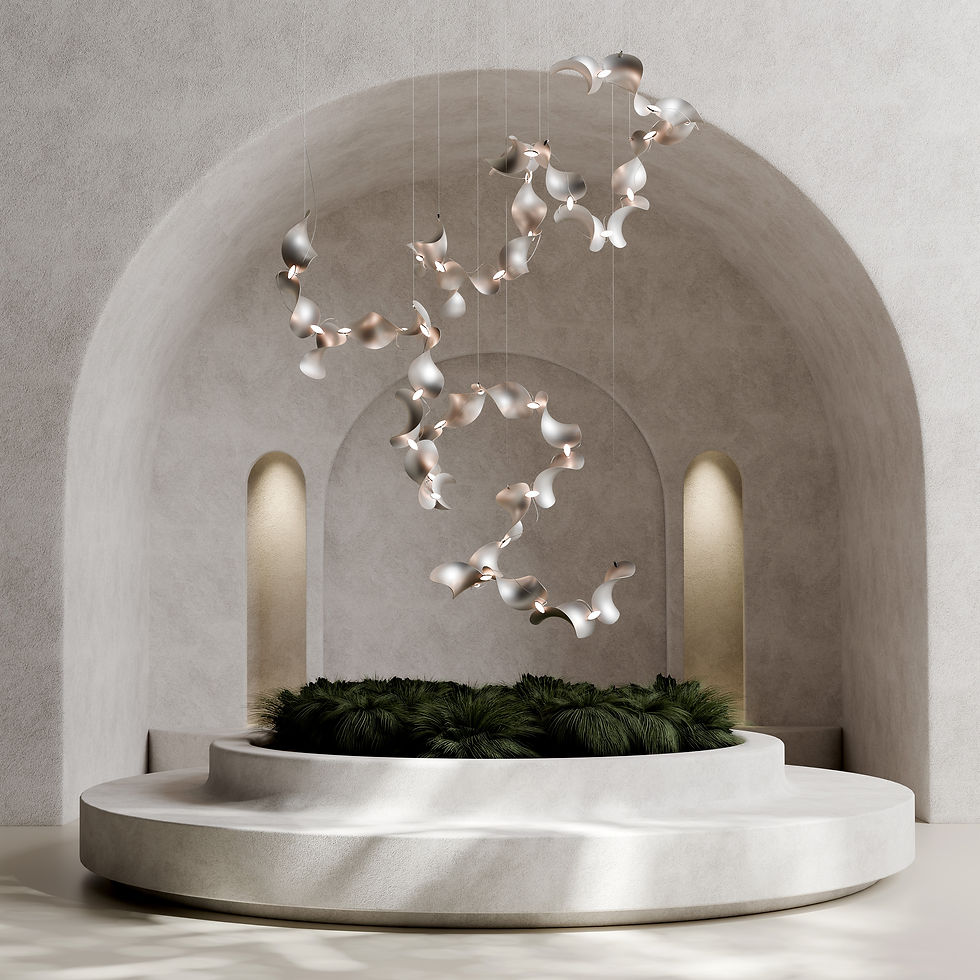
Low Ceiling Pendant Light: The Dune Curve | MOSS
A low ceiling pendant light has to solve a problem that most pendant typologies ignore: it must give a room a defined, readable luminaire without taking the height that people need to move underneath it. In apartments, hotel corridors, restaurant dining rooms with suspended ceilings and refurbished offices, the clear height is often between 250 and 280 cm, and a tall or deep fitting quickly feels like an obstruction. Dune Curve is the configuration of the Dune modular luminaire that MOSS developed for exactly this condition. It keeps the body of the luminaire shallow and lets it travel in plan instead of in section.
This guide is written for interior architects and specifiers who need a sculptural pendant for a room with limited height. It explains how the Curve configuration is built, what the seven sizes measure according to their spec sheets, how suspension and cabling are planned, which finishes and controls are available and where the form tends to work best.
Why a Low Ceiling Pendant Light Needs Horizontal Form
The height of a room is shared between the luminaire and the people using the space. Whatever the luminaire takes in section is lost to circulation, sightlines and the feeling of volume above the furniture. In a double-height lobby that budget is generous, and a vertical or spiralling form can use it. In a room of 260 cm it is not. Here the useful direction for a luminaire is horizontal: along a table, across a seating group, down the length of a corridor.
Dune Curve follows that logic. Every Dune is built from the same components: formed aluminium shades with polycarbonate diffusers, joined by CNC-machined aluminium connectors that each hold two LEDs. In the Curve configuration the shades are linked with 50 cm connecting cables and suspended so that the sequence undulates along a mainly horizontal path. Modular segments create continuous curves, and the line moves through the room rather than down into it.
The effect on height is measurable. According to the spec sheets, the body of a Dune Curve is between 35 and 49 cm tall across all seven sizes, while the length grows from 75 cm to 376 cm. Compare this with the vertical configurations of the same system: the Dune 10 Spiral has a body height of 130 cm and the Dune 6 Vertical Line 175 cm. The shades and connectors are identical. Only the arrangement changes, and with it the amount of section the luminaire claims.
A simple example shows what this means on a drawing. In a room with a ceiling at 260 cm and the lowest shade set at 200 cm above the floor, a Dune 12 Curve with its 40 cm body leaves around 20 cm between the ceiling and the top of the shades. The same clear height would be impossible to hold with a vertical form. A shallow body is what allows a luminaire of more than two metres in length to sit in an ordinary room.
Dune was designed by Daniel Becker and Elisa Bakaniev, received the iF Design Award in 2025 and is handmade in Germany.
Dune Curve Sizes: Reading the Seven Spec Sheets
Dune Curve is available in seven sizes: 4, 6, 8, 10, 12, 16 and 20 shades. The number in the name is the number of shades, and the LED count follows from it: two LEDs per connector, one connector fewer than the number of shades. A Dune 12 Curve therefore has eleven connectors and twenty-two LEDs.
The figures below are taken from the current spec sheets. Height is the body of the luminaire, not the suspension length below the ceiling. Plan dimensions are approximate overall length × width.
Dune 4 Curve: body height 35 cm, approximately 75 × 59 cm. Dune 6 Curve: 45 cm, approximately 120 × 56 cm. Dune 8 Curve: 49 cm, approximately 120 × 80 cm.
Dune 10 Curve: body height 38 cm, approximately 161 × 96 cm. Dune 12 Curve: 40 cm, approximately 204 × 99 cm.
Dune 16 Curve: body height 40 cm, approximately 296 × 102 cm. Dune 20 Curve: 42 cm, approximately 376 × 108 cm.
Two observations help with size selection. First, height does not rise with shade count. The 8 is the tallest Curve at 49 cm, while the 10, 12, 16 and 20 all stay between 38 and 42 cm. Above eight shades the configuration gains length and width, not height, which makes the larger sizes particularly suitable for low rooms with a long plan. Second, the sizes fall into three practical groups. The 4 and 6 are compact objects for a side table, a small dining table or a bedroom. The 8, 10 and 12 match the length of most dining and meeting tables. The 16 and 20 are long, travelling forms for restaurants, lounges and hotel public areas.
For drawings, always work from the spec sheet of the specific model rather than interpolating between sizes. Each sheet carries the dimensions, canopy information, light output and packaging data, and the product pages for the Dune 6 Curve, Dune 12 Curve and Dune 20 Curve link to the drawings.
Suspension, Canopy and Cable Planning for a Low Ceiling Pendant Light
In a low room the suspension detail is visible from almost every position, so it is worth planning carefully. Each Dune is suspended on a combination of SELV coaxial cable and 0.8 mm steel wire. The coaxial cable carries low-voltage power to the connectors, the wire carries the load.
The canopy is always one of the suspension points, because it contains the anchor for a suspension wire. It cannot be placed freely between suspension points, but it can be moved to any of the luminaire's suspension points. Where the project has a fixed junction box or a central outlet, the canopy is assigned to one of the central suspension points and the remaining points are fixed around it. Marking the junction box on the reflected ceiling plan before ordering allows the canopy assignment to be confirmed together with the drawings. Our guide to the pendant light canopy covers ceiling fixing in more detail.
Canopy sizes differ within the range. The Dune 4 Curve uses a compact canopy of Ø 100 × H 40 mm. Sizes 6 to 12 use one canopy of Ø 180 × H 50 mm. The Dune 16 and Dune 20 Curve use two canopies, one for each chain of shades, which means two ceiling outlets need to be planned for the largest sizes.
The standard supply cable from the canopy is 300 cm. On site the electrician shortens it to the finished height, which in a low room usually means a short drop and a significant cut. Longer cables are only needed for high ceilings and are supplied to order as a separate line item. The more important decision in a low room is the height of the lowest shade. Because the Curve undulates, the shades do not all hang at the same level, so it helps to agree the lowest point with the client at specification stage and to show it in a section drawing. Our article on pendant light hanging height sets out the measurements that are most often missed.
Finishes, Light Output and Control
Dune Curve is offered in the same five finishes as the rest of the Dune collection, produced with two processes. Silver Anodised is anodised aluminium and is the stocked finish. Silver Polished is mechanically polished, uncoated aluminium. Gold Tone, Copper Tone and Dark Bronze Tone are lacquered aluminium, built up in several coats with intermediate sanding.
In a low room the finish is seen at close range, so the difference between the processes matters. The anodised surface stays close to the metal with a fine, even reflection. The lacquered tones have more depth and a softer reflection, which suits interiors with timber, stone or textile. Silver Anodised is held in stock, while all other finishes are made to order, which is relevant on tight programmes. Standard lead time is 8 to 12 weeks. Samples show the real process: a silver sample is anodised, a gold, copper or bronze sample is lacquered.
Each LED is rated at 2.1 W and 260 lm at 2700K. Total output scales with size: 1,560 lm for the Dune 4 Curve, 2,600 lm for the 6, 3,640 lm for the 8, 4,680 lm for the 10, 5,720 lm for the 12, 7,800 lm for the 16 and 9,880 lm for the 20. Because the light sources sit in the connectors along the whole length of the Curve, the output is distributed over the table or seating area below instead of being concentrated at one point. For a low ceiling this is an advantage: no single source sits close to eye level with a high output.
Driver selection follows the project location. TRIAC dimming is the European standard, 0-10 V or 1-10 V is standard for 110 V markets in the US, and DALI is available as an option. The driver is confirmed with the order so that it matches the building's control system.
Custom lacquer colours and two-tone combinations, for example a canopy in one tone and shades in another, are possible as project configurations. They are priced and scheduled separately and confirmed with samples.
Where the Dune Curve Works in a Project
The Curve is most useful where the plan is long and the section is tight. A few situations come up repeatedly in projects.
Over dining and meeting tables, the 8, 10 and 12 follow the length of the table and keep the volume above it open. Aligning the long axis of the luminaire with the table, and keeping its footprint inside the table outline, holds the object together visually and avoids shades hanging over circulation routes.
In restaurants and hotel lounges with suspended ceilings, the 16 and 20 can run along the room or over a banquette. Their two canopies allow the luminaire to be fixed to two ceiling outlets, which often suits the grid of an existing suspended ceiling. In refurbishments, where ceiling heights are fixed, the shallow body is frequently the reason the Curve is chosen over other Dune configurations.
In residential projects, the compact 4 and 6 work over a kitchen island, a small dining table or a bedside area in rooms where a vertical cluster would crowd the space. Because the shades are open forms with light in the joints, the luminaire also reads clearly when seen from a sofa or a bed, at a low angle.
Draw the luminaire in section as well as in plan. Show the ceiling, the canopy, the highest and lowest shade and the furniture below. In a low room the margins are a few centimetres, and a section agreed early prevents adjustments on site.
Dune Curve also combines well with other Dune configurations in the same project, because the shades, connectors and finishes are identical. A Curve in a low dining room and a Spiral in an adjacent stair void share material and detailing while answering different spatial conditions. For the vertical counterpart, see our guide to the spiral pendant light.
For dimensions, configurations and finish details across the whole collection, see the Dune pendant light guide or open the Dune 10 Curve product page.
For full specifications, drawings and finish samples of the Dune Curve range, or to discuss a configuration for a specific project, contact MOSS Objects directly.