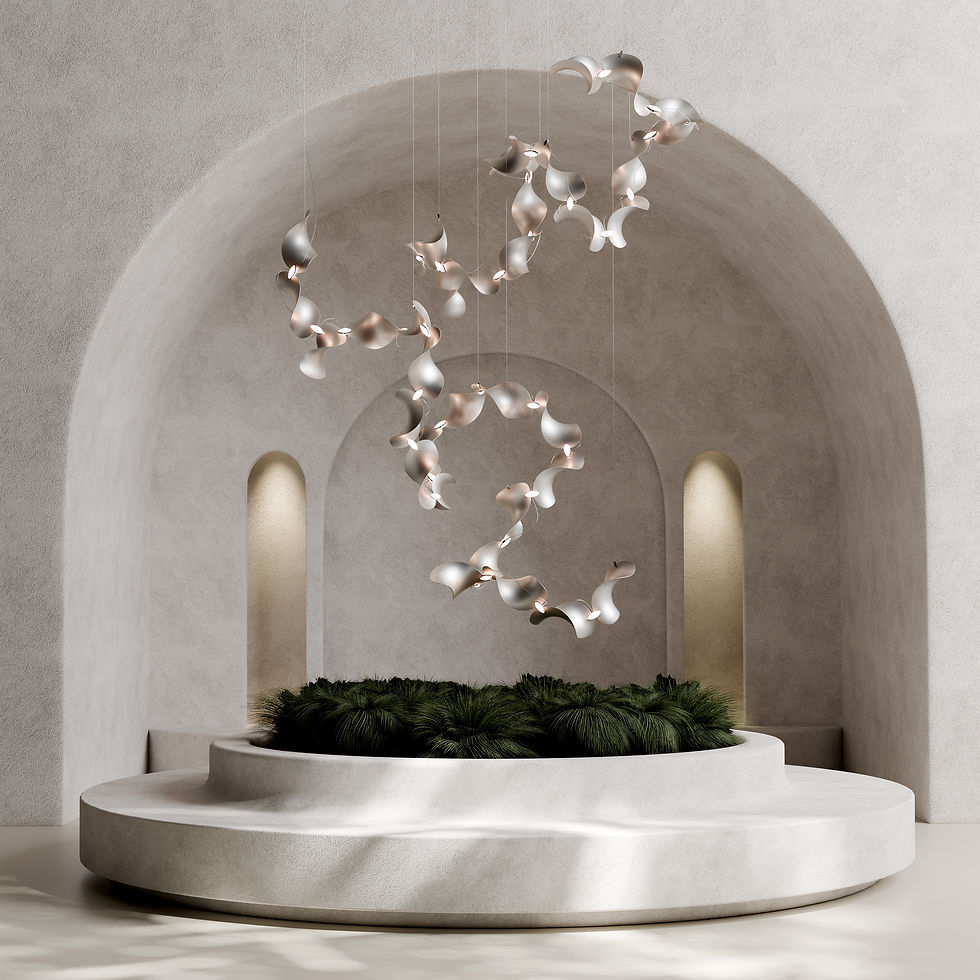
The MOSS Lighting Collections: Dune, Emily and Kosmos
Updated: Aug 15
Three MOSS Lighting Collections: An Architect's Guide to Dune, Emily, and Kosmos
The MOSS lighting collections are not a range in the conventional sense. They are three distinct formal languages, each addressing a different relationship between light, form, and space. Choosing between them is an architectural decision as much as a product decision.
Dune: The Directional MOSS Lighting Collection
Dune takes its name from the way sand organises itself under wind: long curves with sharp ridges, forms generated by a consistent force acting on a yielding material. The shades press and fold sheet metal into geometries that direct light deliberately: downward and to the sides, blocked completely above. The result is a pool of warm light beneath the fixture and a gradual fade into darkness above, rooms feel taller than they measure.
Dune is particularly effective in spaces with architectural character (exposed concrete, panelled walls, herringbone floors) where directional light reveals surface texture rather than suppressing it. Available in Dark Bronze, Copper, and Gold lacquered finishes. Configurations: Dune Pendant, Dune Curve, Dune Cluster.
Emily: Form Language, Standard Finishes, and Emily Oxid
Emily is a separate collection with its own compact form language, not a finish option applied to Dune or Kosmos. The Emily pendant is available in a range of standard lacquered finishes; Anthracite semi-matte is the bestselling Emily finish and works across a wide range of interior contexts. Other lacquered finishes are available to order.
A special variant, Emily Oxid, is defined by a material circumstance rather than a design decision: the metal sheets used for Emily Oxid pieces spent several decades ageing naturally in a barn, developing an organic patina that cannot be reproduced. The stock of aged metal is finite. Emily Oxid is a limited, irreplaceable option within the Emily collection, not available across other MOSS collections.
Kosmos: Geometry and Polished Precision
Where Dune works with curves and shadow, and Emily with considered form and material depth, Kosmos is about geometric precision and reflective surface. The forms are clean volumes (spheres, cylinders, cones) finished in polished brass or polished nickel. Kosmos reflects the room back into itself: ceiling, walls, and light source all appearing in miniature within the curved surface of the fixture.
Architects specify Kosmos for interiors where the lighting element is intended to read as a deliberate object, a jewel rather than a tool. In minimalist spaces, it introduces material richness without visual complexity. In more layered rooms, it provides a point of clarity.
Choosing Between the MOSS Lighting Collections
The decision is architectural rather than aesthetic. Dune is specified for spaces where the quality of shadow matters, where the lamp’s primary contribution is to reveal the room’s surfaces and give it depth. Emily is specified when the form language of the collection suits the space: with standard finishes for controlled material consistency, or Emily Oxid when genuine historical material substance is the point. Kosmos is specified when precision and reflectivity are the defining contribution.
All three MOSS lighting collections are available through the MOSS Trade Program. Finish samples, technical data, and project enquiries: info@mossobjects.com.
The full range: the collection.